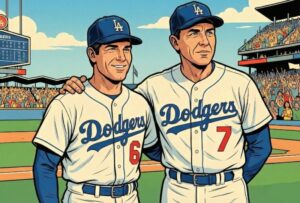
The Los Angeles Dodgers enter September 2025 with one goal that overshadows every other storyline in Major League Baseball: repeating as World Series champions. Their 2024 victory against the New York Yankees confirmed their dominance, yet the pursuit of consecutive championships places them in rare company.
No team has defended its crown since the Yankees completed their famous three-peat between 1998 and 2000. The Dodgers, armed with one of the most talented rosters in modern history, are aiming to carve out a place in baseball lore, while proving they are more than a one-time wonder.
The Road to the Repeat: Building on 2024’s Championship
The Dodgers’ 2024 title run carried enormous weight. Many skeptics questioned their legitimacy after their first championship in the shortened 2020 season, but last year’s triumph silenced that narrative. Beating the Yankees in five games demonstrated star power and resilience.
Management wasted no time strengthening the roster, acquiring Shohei Ohtani and Yoshinobu Yamamoto while keeping their core of Mookie Betts and Freddie Freeman intact. That approach showed that management is determined to build more than just a contender; they’re intent on the daunting task of shaping a dynasty.
Only 14 teams in MLB history have managed consecutive titles, and the path to repeating involves more than stacking talent. Injuries, slumps, and postseason unpredictability make the challenge tougher.
Coaches and analysts emphasize that navigating the grind requires managing player highs and lows with precision, and the growing reliance on advanced analytics shows how coaches use player data to manage slumps and hot streaks. The Dodgers have resources and talent, but they must focus on sustaining cohesion to match the greatest of baseball’s elite.
Consistency and Cracks: The Dodgers’ 2025 Season Storyline
The 2025 season began with the Dodgers roaring out of the gate. They became only the second defending champion in history to open 7-0, later pushing that streak to 9-2. Their dominance over the past decade is undeniable. A .608 win percentage across 13 years, 11 division titles in that span, and unmatched consistency put them in rare company.
For many, the Dodgers already resemble a dynasty. Recent weeks have added nuance. Losses to the Pirates and Diamondbacks revealed a tendency to play down to competition, while pitching inconsistencies resurfaced. Even Clayton Kershaw, a franchise icon, endured a rocky outing where early mistakes proved costly.
Offensively, the lineup can explode in a single inning with massive home runs, such as Ohtani’s 120-mph blast, yet struggles to produce outside those bursts. Individual performances illustrate the duality of their season. Ohtani continues to deliver at an MVP level with 46 home runs and an OPS near 1.000, while Betts remains productive, though his batting average has dipped.
Freeman provides reliability at the plate with his near .300 average. Yamamoto has emerged as a workhorse with a sub-3.00 ERA, while Tyler Glasnow’s outings remain inconsistent. Despite these cracks, the Dodgers remain the team to beat.
Their status as favorites is reflected in the current FanDuel MLB World Series odds, where their star power and track record sustain belief in their October chances. The balance of elite talent and postseason volatility defines their journey.
Echoes of Greatness: Comparing Dodgers to the 1990s Yankees
Any conversation about dynasties inevitably circles back to the Yankees of the late 1990s. Those teams won four titles in five years, including a run of three straight, setting a standard few franchises have approached. The Dodgers invite comparisons because of their winning culture, marquee roster, and ability to attract elite talent.
The environment in Los Angeles has lured stars in the same way New York once did, most notably Shohei Ohtani and Yoshinobu Yamamoto. Both franchises thrive under immense expectations. The Yankees’ “Core Four” anchored a consistent roster, while the Dodgers pair homegrown pieces with global headliners. The key difference lies in construction.
New York leaned on drafted and developed players, whereas Los Angeles built aggressively through trades and free agency, a superteam approach borrowed from basketball. Sustained postseason success is another dividing line.
The Yankees delivered in October year after year, while the Dodgers have occasionally fallen short despite regular-season dominance.
Expanded playoffs add rounds and randomness, magnifying the challenge of replicating New York’s run. The Dodgers counter with their own identity, excelling in baserunning and aggressive defense. Betts and Freeman routinely exploit gaps, turning small openings into game-changing moments. Comparisons to the Yankees also highlight modern performance.
Fans who want to see how Dodgers stars stack up across the league can explore the latest MLB player stats and trends, where Ohtani’s thunderous production and Yamamoto’s efficiency underscore the power behind this roster.
October Pressure and the Weight of Legacy
The postseason is where legacies are cemented, and the Dodgers face the most significant test of their era. Expanded playoffs mean more rounds, more opponents, and less margin for error. Short series often favor underdogs, with a few bad innings enough to swing momentum. This unpredictability makes consecutive championships difficult, even for loaded rosters.
The Yankees of the 1990s separated themselves not only through talent but also through relentless focus. They never let opponents dictate tempo and rarely slipped against weaker teams.
The Dodgers, on the other hand, occasionally show vulnerability in that department. Their September lapses against non-contenders raise questions about discipline and concentration, elements that weigh heavily in October.
Yet the Dodgers’ opportunity is undeniable. A repeat would elevate them beyond being a powerhouse of the moment into a dynasty remembered for decades. For Ohtani, Betts, and Freeman, this postseason represents more than another playoff run.
It’s a chance to join a lineage of baseball immortals. For fans, it offers the intrigue of whether modern baseball, with its expanded playoff gauntlet, can still produce dynasties of old.
The Dodgers’ Place in Baseball History
The Dodgers have already established themselves as one of the premier franchises of the 21st century. Their run of dominance, capped by two championships in five years, underscores a model of aggressive management and consistent excellence.
Yet the story of the 2025 Dodgers is not complete. Their push for a repeat carries the weight of history and the possibility of redefining what a modern dynasty looks like. Should they capture another title, comparisons to the Yankees of the late 1990s will shift from speculative to concrete. Even if they fall short, the conversation around their era-defining talent will continue.
What makes this season compelling is not just the star-studded roster or record-setting pace but the drama of whether they can sustain their greatness under the unique pressures of October.
Fans will watch closely as the Dodgers chase more than victories. They are chasing a legacy, and the outcome of this postseason may decide how baseball remembers them.