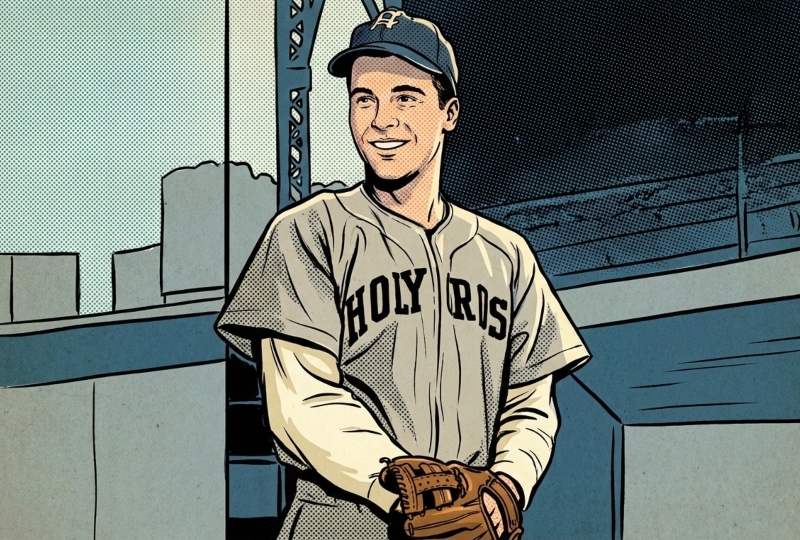
A teetotaler and a Catholic who attended mass every morning, “Black Jack” Barry stood out among the foul-mouthed, hard-drinking ballplayers of the early twentieth century. He studied at the side of Connie Mack, learning the ins and outs of deadball era baseball. Barry was a winner before he came to Mack’s Philadelphia Athletics, he won a lot with the club, and after his playing career when he took the head coaching job at his alma mater, he won more often than anyone in college history.
At Holy Cross as a player
Barry’s high school team in Connecticut captured two state titles and enjoyed a 47-game winning streak. He strolled onto the campus of Holy Cross in Worcester, Massachusetts in 1902 and earned a spot on the baseball team, working his way into the role of team captain. Barry was skinny and ran with a hopping motion, earning the nickname “Bunny.” He helped Holy Cross to three conference titles and led the team in runs scored every year he was in the lineup. When he emerged as a college graduate he was courted by almost every team in major league baseball. But Mack had a trump card: his brother was an innkeeper in Worcester and he wormed his way to Barry, forging a relationship that inched the young infielder to the A’s. Connie got his man for a $750 signing bonus.
The $100,000 Infield
Second baseman Eddie Collins and Barry became a duo in Jack’s rookie season, which was also the first year Collins played regularly. Collins had attended Columbia University and was a very smart ballplayer too. Mack played his college-graduate double play combo for seven years and they helped the A’s to four pennants and three World Series titles. Collins and Barry were good friends, though Eddie was much more aggressive on the diamond. Barry was the least heralded member of Philadelphia’s great infield, which also included first baseman Stuffy McInnis and third baseman Frank “Home Run” Baker. They were dubbed “The $100,000 Infield.”
Nearly died from a pitch that struck him in the head
Mack sold off his stars rather than keep up with the salary increases caused in part by the rival Federal League, Barry going to the Red Sox, close to home. In Boston, Barry won some more, playing second base for two championship clubs. During the 1916 season, with Boston marching to a second straight pennant, Barry nearly lost his life. On August 29, in a game against the Browns at Fenway Park, Barry was struck in the forehead by a pitch from Dave Davenport. He lay motionless for several minutes before his lifeless body was carried from the field. Barry spent a week in the hospital before he was released, but he did not play again that season. He was only 29 years old and never played regularly again.
Coach at Holy Cross: a College World Series title
When America tumbled into the First World War, Barry enlisted in the Naval Reserve and missed a full season. He came back with bum knees and the Red Sox traded him back to Philadelphia where he was unable to play through his injuries and retired.
A few years later Holy Cross offered him the head coaching job and Barry jumped at it. He and his wife loved living in Worcester and they became celebrities in the community as Barry guided Holy Cross to wins in more than 80 percent of their games for the next 40 years. His 1952 team won the College World Series and Barry sent more than two dozen players to the majors. He died from lung cancer during the 1961 season at the age of 73. His winning percentage at Holy Cross is still the highest for any college baseball coach in NCAA history.