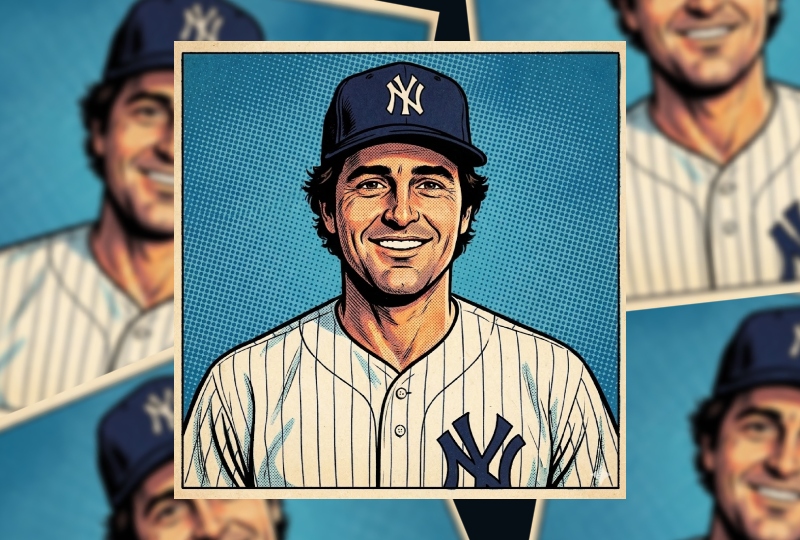
Russel Earl Dent hit 40 home runs in a 12-year big league career. He never hit a home run in the postseason. But he is remembered almost exclusively due to an iconic home run he sent soaring into the net above the famed Green Monster in left field at Fenway Park.
Few trades have altered the fortunes of a ballplayer more than the one orchestrated on the eve of the 1977 season. The Yankees had just spent the spring in Tampa watching a group of wannabes try to win the shortstop job. None of them could claim it..
The failed candidates at shortstop that spring included incumbent Fred Stanley, a man so physically putrid he was called “The Chicken.” Then there was Mickey Kluttz, a 22-year old middle infielder with a strong arm, and Greg Pryor, another unproven player acquired in February from the Texas Rangers. The Yankees also auditioned Brian Doyle, who came to them in the same trade that brought Pryor.
Not one of the quartet the Yankees tried at shortstop in the spring of ‘77 was what manager Billy Martin was looking for. Billy, himself a former middle infielder, was looking for a quick, scrappy player in his own mold. He wanted a player who would be fearless crossing the bag to turn double plays, a player ready to be part of a winning club. He wanted someone like the kid in Chicago: Bucky Dent.
For weeks, Yankee general manager Gabe Paul worked the phones in an attempt to wrestle Dent away from the White Sox. His counterpart was a man named Roland Hemond, a former scouting director and protege of Chuck Tanner. For weeks, Hemond politely answered inquiries from Paul, but he didn’t want to part with Dent.
“Our pitching staff loved Bucky,” Hemond said. “He was a great shortstop, and we loved him in the clubhouse too.”
But Hemond also liked winning, and with Dent the White Sox lost 97 games in 1976. The team needed a lot of help. Gradually, Hemond started to realize that he could extract a hefty price for his shortstop because the Yankees were smitten.
Finally, as the Yankees packed their gear to head north for the start of the 1977 season, Paul knew he had to make Dent a Yankee somehow. Even if only to shut up Martin, who by this time was begging for a new shortstop.
Finally, two days before opening day, Hemond coaxed Paul to send Oscar Gamble and minor league pitcher LaMarr Hoyt to Chicago for Dent. How bad did Paul want Bucky? He also paid the White Sox $200,000 in the deal.
The Yankees didn’t care much about the money. They would miss the lefthanded power bat of Gamble, but they got their man. On opening day, Dent was in the lineup at Yankee Stadium. He went on to play 158 games. His steady play at shortstop solidified the middle of the infield. His presence in the clubhouse helped calm a team that often brewed in turmoil.
Had Martin not coveted Dent, and had Paul not pursued the little shortstop with such zest, we may not have ever heard much from Bucky. He was easy to overlook.
“Everything changed once I [arrived] in New York,” Dent said. “My life was never the same, and sometimes I thought it was a dream.”
Dent and second baseman Willie Randolph teamed to form one of baseball’s best defensive units up the middle. Not just for that time, but ever. Both were magicians with the glove. Dent had excellent range up the middle, and he was fantastic at going back on the ball. His range helped cover the defensive lapses of more than one shaky Yankee left fielder. His throwing arm was legendarily strong.
Bucky was the starting shortstop for the Yankees in five seasons. The team won the pennant three times and averaged 98 wins in the four full schedule seasons he was in place at the position. He was an All-Star twice, and should have won at least one Gold Glove, but Mark Belanger and later Alan Trammell were winning that honor.
In 1978, in Game 163 to decide the division title, Bucky hit his famous home run in Boston. It was a three-run blast that turned a deficit into a lead, and shook the Sox so much that left fielder Carl Yastrzemski, watching the ball go over the wall, nearly fell to his knees. Dent choked up on the bat at least five inches when he made contact. A few days later, the Yankees won their second straight title. Dent was named World Series MVP when he had 10 hits and seven RBI.
Dent was basically the last “no hit, good field” scrawny shortstop to be a star. By the time he was fading out of the major leagues, shortstops were winning MVPs and batting cleanup. His final game was in 1984 for the Royals.
George Steinbrenner loved Bucky Dent. He was one of the Boss’s favorite players. Upon his retirement as a player, Dent was hired to manage the Fort Lauderdale Yankees. Within a few years he advanced to Triple-A at the helm of the Columbus Clippers. In 1989, when Steinbrenner fired Dallas Green, he named Dent as the new manager of the Yankees.
Bucky never had the chance to become a champion as a manager. He lasted fewer than 100 games in parts of two seasons, before he was fired by BIg George. Even the owners’ favorite ballplayer can lose his job.