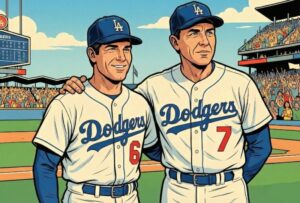
The Los Angeles Dodgers of 2025 have entered rarefied air. After capturing their second straight World Series title, this team has drawn comparisons to some of the most legendary championship squads in baseball history.
With Shohei Ohtani leading the charge, and Mookie Betts and Freddie Freeman anchoring a deep, balanced lineup, the Dodgers have become a modern symbol of sustained excellence.
The question now looms over the champions: how do the 2025 Dodgers truly measure up to the all-time greats, the 1927 Yankees, the 1975 Reds, the 1998 Yankees, and the 2016 Cubs?
In this article, we’ll take a deep dive to answer these questions.
Offensive Power and Depth: Echoes of Historic Lineups
The Dodgers’ 2025 offense was a spectacle of balance and thunder. Ohtani’s 55 home runs and .282 average made him the team’s heartbeat, while Freeman and Will Smith provided steady production behind him.
To understand where they stand among the all-time greats, it helps to look at how their lineup compares to a few of baseball’s legendary champions:
- 1927 Yankees: Ruth and Gehrig’s “Murderers’ Row” was baseball’s gold standard, powering nearly 1000 runs in a year when offense reigned supreme,
- 1975 Reds: The “Big Red Machine” produced runs through speed and situational hitting, with Joe Morgan and Johnny Bench as dual threats,
- 1998 Yankees: A balanced attack with Jeter, Williams, and Martinez delivered consistent production without relying on a single superstar,
- 2016 Cubs: A young, fiery group led by Kris Bryant and Anthony Rizzo, who overwhelmed opponents with power and plate discipline.
The 2025 Dodgers blend traits from each: the raw power of the Yankees, the depth of the Reds, and the efficiency of the late-’90s Yankees.
Every inning, every at-bat, feels like a calculated strategic move. They’re not just slugging; they’re executing a plan.
Building a Modern Dynasty Through Roster Design
Dynasties are rarely built overnight. The Dodgers’ success stems from meticulous roster design, an organizational commitment to versatility, analytics, and player development.
The front office’s model mirrors the 1998 Yankees, who relied on roster depth and chemistry rather than individual superstardom.
This depth has given the Dodgers resilience when stars falter. Injuries to Tommy Edman and Mookie Betts didn’t derail the season because the bench stepped up seamlessly. That next-man-up mentality isn’t flashy, but it’s the foundation of sustained greatness.
As fans track every lineup shuffle and pennant push, many follow the league’s daily pulse, from standings and box scores to exploring where to bet on MLB games to stay engaged with the sport’s biggest storylines. It’s all part of evaluating a modern dynasty in motion.
Pitching Greatness: A Tale of Strength and Vulnerability
The Dodgers’ pitching story in 2025 was one of duality: a bruised regular-season rotation that transformed into a postseason juggernaut.
When lined up against baseball’s most dominant staffs, the contrasts are striking:
- 2025 Dodgers: A regular-season ERA of 3.86 masked a remarkable postseason ERA of 1.54,
- 1998 Yankees: Cone and Wells provided consistency, while Mariano Rivera closed out games with surgical precision,
- 2016 Cubs: The league’s best rotation from wire to wire, anchored by Arrieta and Lester,
- 1975 Reds: Effective, but secondary to their offense, ranking third in the NL in ERA.
The Dodgers’ arms told two stories, vulnerable in the grind of summer, nearly untouchable in October. Their bullpen-heavy approach reflects the modern game’s evolution, where strategy and depth can rival raw talent.
In that sense, the Dodgers’ postseason dominance places them firmly within the pantheon of baseball’s most adaptable champions.
Star Power and Team Identity: The Balance of Brilliance
Championship teams are defined by their stars. For the Dodgers, Ohtani, Betts, and Freeman form a trio reminiscent of baseball’s legendary cores, Ruth and Gehrig for the ’27 Yankees, or Bench, Morgan, and Rose for the ’75 Reds.
Yet the Dodgers’ magic lies not only in their stars but in how the rest of the roster complements them. Ohtani’s once-in-a-generation skill set electrifies the lineup, Freeman embodies consistency, and Betts provides quiet leadership. Together, they symbolize the modern athlete: measured, disciplined, and team-oriented.
This balance between superstar power and collective execution feels distinctly 21st century and distinctly Dodger.
Sustaining Greatness: What Separates the Dynasties
Beating history once is difficult. Outlasting it is something else entirely.
Looking back at the great champions reveals the blueprint the Dodgers must follow to join baseball’s true dynasties:
- 1990s Yankees: Sustained excellence through balance, trust, and player development,
- 1970s Reds: Chemistry-driven dominance that thrived on continuity,
- 2016 Cubs: Flashed brilliance but couldn’t extend their window.
The Dodgers’ test lies in durability and focus. To match those dynasties, they must maintain health, depth, and consistency year after year. Sustaining this level of excellence separates a “great team” from a historic one.
As Baseball Egg’s feature on underrated players points out, even the brightest teams rely on role players who quietly define eras. For the Dodgers, it’s those unsung contributors, the steady utility hitters, clutch relievers, and adaptable bench players whose impact often proves just as vital as the stars.
Redefining Greatness in the Modern Era
The Dodgers’ rise underscores a broader truth: baseball greatness looks different today. In the past, it was about sheer dominance. Now, it’s about adaptability, managing data, preserving arms, and maximizing every roster spot.
The Dodgers have mastered that new formula. Their front office treats roster construction like an evolving puzzle, blending intuition with metrics. The result is a team that wins with brains as much as brawn.
For those who follow the deeper story behind this transformation, MLB team news and analysis provide a richer look into how the Dodgers and others like them are redefining what championship baseball means in the analytics era.
Where the Yankees once ruled by dominance, the Dodgers thrive on precision.
A Legacy Still in Motion
The 2025 Dodgers have earned their place in baseball’s ongoing conversation about greatness. Their combination of superstars, depth, and data-driven discipline puts them shoulder to shoulder with some of history’s finest teams.
Are they the equals of the 1927 Yankees or the 1998 Yankees? Not yet, but time will tell. Yet, the Dodgers have laid the foundation, two titles, historic postseason pitching, and a culture that breeds success.
If they capture a third straight championship in 2026, the debate may be over. The Dodgers won’t just compare to baseball’s greatest championship teams; they’ll join them, etching a new chapter in the game’s ever-evolving definition of greatness.