
Did Ty Cobb play for the Kansas City Royals? Does Tony Gwynn hold the record for most batting titles? With which team did Babe Ruth end his career?
These questions are simple to answer for a serious baseball fan, or anyone who logs onto the internet and their favorite search engine. At least that should be the case.
But a recent examination of online resources and artificial intelligence tools reveals that wrong answers are far too common when searching for answers to baseball questions.
Google’s Featured Snippets Doesn’t Know Baseball Teams
Often when you type a query into Google, the search engine returns a response at the top of the ensuing page that attempts to answer your question. In this manner, Google hopes to satisfy your query without you having to click a search result and go to a website. This is called a “Featured Snippet.”
An example of a Google Featured Snippet would be a birthdate or alive/dead status. For example, if you typed in “Is Tom Seaver alive?” you would receive a response from Google on the Search Engine Results Page (SERP) that shows the Hall of Fame pitcher died on “August 31, 2020 (age 75 years), [in] Calistoga, CA.” This response is helpful, and it’s accurate.
But, Google can get too ambitious with its Featured Snippets, especially when it comes to statistics. Here’s what Google returns if you search for “Ty Cobb stats”:
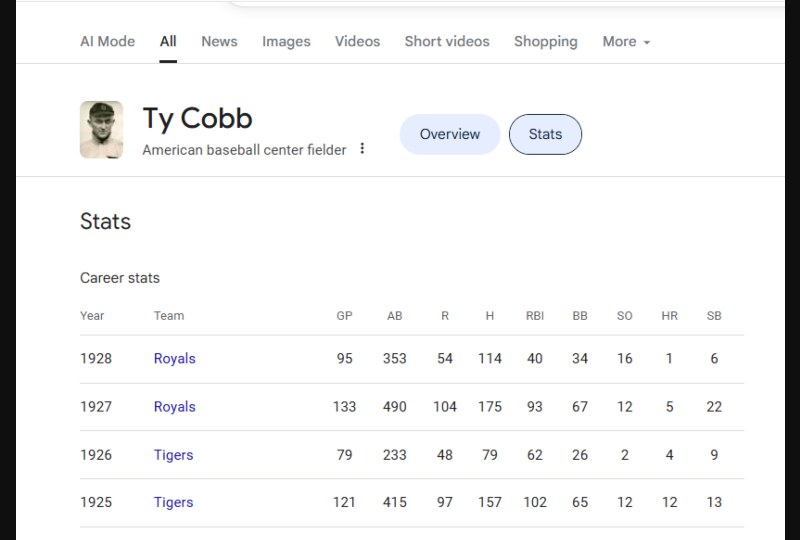
Google thinks Cobb played his final two seasons for the Kansas City Royals. Of course, the Royals didn’t join the American League until 1969, 41 years after Cobb played his final game, and eight years after Ty died. How can Google get that information incorrect?
Clearly, Google is pulling the statistical data for MLB players from a source that does not have accurate franchise information for baseball teams. Cobb played the 1927 and 1928 seasons for the Philadelphia Athletics. That team later moved to Kansas City in 1955. For some reason, Google’s Featured Snippet stats for Cobb thinks the Philadelphia A’s are actually the team that played in Kansas City from 1955 to 1967. It further assumes that any MLB team in Kansas City must be the “Royals.” Of course that’s wrong.
The incorrect team information for MLB statistics in Featured Snippets has been wrong in Google for several years. Similarly, Rogers Hornsby, a Hall of Fame second baseman, is listed as having spent the last four years of his career with the Orioles. In the 1930s, when Hornsby was winding down his career, the Orioles were a minor league team. In actuality, Hornsby played from 1934-1937 for the St. Louis Browns. That team later relocated to Baltimore to become the Orioles, competing in the American League.
Worse yet for the end user: the Featured Snippet adds links to each season for the teams listed. That means if you click on the “Orioles” link presented for Hornsby’s 1935 season, for example, it goes to a SERP that presents information about the Baltimore Orioles. This is not useful, for obvious reasons.
Reddit Answers are Unreliable
Most likely, you won’t be surprised that Reddit cannot be trusted in many cases. The user-driven platform made up of communities built around hyper-specific topics called “subreddits” has long been criticized as a echo chambers for misinformation. According to my research, when it comes to baseball data, Reddit should not be a resource.
Reddit launched “Reddit Answers” in 2025, a Q&A tool powered by Artificial Intelligence. Shortly after it was launched into Beta earlier this year, Google revealed that Reddit Answers is powered by its Gemini technology. As we learned in the above example about Featured Snippets, this should make users worry.
In actuality, it doesn’t seem that Reddit Answers is using an AI model to answer user questions. Instead, it lists probable answers to a query based on a search of Reddit and its subreddit content.
Here’s an example of what I got from Reddit Answers for this question: How many batting titles did Ty Cobb win?
Ty Cobb was a legendary baseball player who had an illustrious career. Here’s a summary of his achievements, including the number of batting titles he won:
Batting Titles
Ty Cobb won a total of 12 batting titles in his career. This is a significant achievement, and he held the record for the most batting titles until it was broken by Tony Gwynn in 1997.
- 1907-1919: Cobb won nine consecutive batting titles from 1907 to 1915. “Cobb has the highest career batting average in baseball history. When he retired after the 1928 season, he held 90 major league records.”
- 1921-1922: He added two more batting titles in 1921 and 1922. “Cobb was a 6-foot-1, 175-pounder who threw right (average arm) and batted left. He kept his hands about three inches apart so he could place hits better. When he retired in 1928, he had set some 90 records.”
- 1925: Cobb won his final batting title in 1925. “Cobb, like Veblen, made extraordinary contributions to his profession. Biographies of Cobb by Al Stump (1994), Charles Alexander (1984), David McCallum (1975), Gene Schoor (1952), and Richard Bak (1994); his autobiography ghost written by Stump (1961); a novel titled Tyrus (Creevy 2002); and the statistical record document his achievements both on and off the field.”
There are several things wrong with the response supplied by Reddit Answers. Cobb did not win batting titles in 1921 and 1922 (he finished second both of those years). He did not win his final batting title in 1925. His actual final batting title came in 1919. Most glaringly, Reddit tells the user that Cobb’s record for most batting titles was broken by Tony Gwynn in 1997. Neither Gwynn nor anyone else has ever matched or exceeded Cobb’s record 12 batting titles. Gwynn won his eighth and final batting crown in 1997.
Even Baseball Reference can be Inaccurate
The website baseball-reference.com is a remarkable achievement. The work done by Sean Forman and his team to make Baseball Reference available as an exhaustingly comprehensive online database deserves praise. It’s a tool I use nearly every day.
But even Baseball Reference can be (at least technically) inaccurate. Let’s revisit Cobb once more.
Baseball Reference bases its statistics on a data set derived from the work of Sean Lahman, who first produced a website with MLB stats in the 1990s. However, while Baseball Reference is considered by most baseball fans and baseball industry members as the de facto source for baseball numbers, the stats presented on the site are not always official.
Cobb is listed as having 4,189 career hits according to Baseball Reference. On MLB.com, which lists the “official statistics of Major League Baseball,” Cobb is credited with 4,191. That number is indeed the official sanctioned total by MLB. Likewise, any stats listed on MLB that are prior to 1920 in the case of earned runs for most pitchers, do not coincide with what you will find on Baseball Reference.
Forman has made the decision to list stats on his site from sources not considered official by MLB. In most cases this makes no difference. But in some instances, it leads to a discrepency.
Biographical data can be incorrect on Baseball Reference, too. Most likely this occurs because the meta data for those details (birthdate, birth city, etc.) are being pulled from many sources, of which accuracy is often not a priority. For years, the birthplace of Rickey Henderson was not listed accurately on Baseball Reference, though it now has been fixed.
Political correctness has also led to many biographical details being altered on Baseball Reference. While I applaud efforts to educate fans on the names and associated cultural prejudices that may have been attached to them in bygone eras, this decision is curious, and in my opinion, unnecesary.
if you search Baseball Reference for Hall of Fame pitcher “Chief Bender,” you will not have a result (at least from the context-sensitive search box). That’s because any culturally sensitive names like Chief have been erased from the data set for first name. Even though Bender was known almost exclusively as Chief during his adulthood and in his professional baseball career, Baseball Reference lists him as “Albert Bender.” Likewise, Chief Meyers, the great Giants’ catcher of the Deadball Era, is listed as “Jack Meyers.” Interestingly, players who earned the nickname “Dixie” as their common first name, are listed under that name, which come would say is pejorative of the south.
There are dozens of examples of players whose names are spelled incorrectly on Baseball Reference because the website decides to list them under their birth spelling. In many cases, the data was discovered years later by researchers. But these ballplayers never spelled their names in that manner in their entire lives. An example is Hall of Fame pitcher Stan Coveleskie, who is listed as Coveleski. This decision likely stems from the very tight partnership Baseball Reference has with the Society for American Baseball Research (SABR), which has made a mission out of “correcting” names retroactively.
Yet, SABR gets it wrong nearly as often as it gets things right in regards to surnames of ballplayers. Often, SABR assumes that their active author roster knows better than anyone else. They simply don’t.
These examples of mistakes from Google calls into question the credibility of that search engine as a source. Similarly, Reddit and Sports Reference (specifically BASEBALL-REFERENCE.COM) can be unreliable.